Cardano Staking Explained: How ADA Delegation Really Works
Cardano staking is delegation: you point your ADA's stake weight at a stake pool while the coins stay in your own wallet, spendable at any moment. There is no lock-up, no minimum and no slashing, and the only upfront cost is a refundable 2 ADA deposit to register your stake address. The trade-offs are smaller than on most networks but real. Your first reward takes 15 to 20 days to arrive, pools deduct a fixed cost and a margin, and since January 2025 you must choose a DRep before you can withdraw rewards.
What does it pay? Working from Cardano's own on-chain totals, rewards for epoch 660 (6 to 11 October 2026) came to about 6.22 million ADA on 21.27 billion ADA of active stake, roughly 2.1% a year once annualised, before your pool's fees. That figure moves every epoch and is paid in ADA, whose price can fall far more than 2% in a day. This field note explains the mechanics, the timing and the routes, using Cardano's documentation and protocol data read on 18 October 2026.
How Cardano staking works: delegation, not lock-up
Cardano runs on a proof-of-stake protocol called Ouroboros, in which stake pools produce blocks in proportion to the ADA delegated to them. Cardano's documentation describes three ways to take part: run your own pool, pay a third party to run a private pool, or delegate to a public pool. Almost everyone takes the third route, and it costs nothing beyond normal transaction fees once your stake address is registered.
The mechanism is a certificate, not a transfer. Your wallet posts a registration certificate for your stake key, paying the 2 ADA deposit, and a delegation certificate naming the pool. Cardano's developer portal is blunt about what follows: your ADA never leaves your wallet, it stays liquid, any amount counts, and add-ons are automatic, so new ADA sent to the same wallet is counted from the next snapshot. If you later deregister, the deposit comes back.
That design is why Cardano's own FAQ says the worst that can happen to a delegator is a pool that underperforms, which means fewer rewards for that epoch, never a penalty on your ADA. Compare that with Ethereum, where a validator can lose stake for misbehaving; our note on what slashing is covers the networks where it applies.
When do you get your first ADA reward?
Cardano counts time in epochs of five days, and a new delegation passes through four of them before it pays. The stake snapshot is taken at the boundary after you delegate, the pool uses your stake in the following epoch, rewards are calculated in the one after, and they land in the next. Cardano's developer portal puts the initial delay at about 15 to 20 days, depending on where in an epoch you delegate. After that, rewards arrive every epoch for as long as the pool keeps producing blocks.
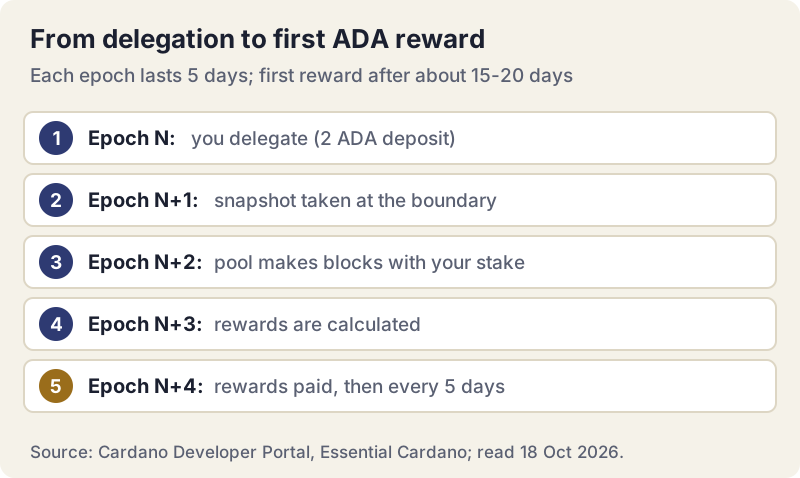
One consequence is easy to miss. Rewards accrue in a separate reward account linked to your stake key, so they are not part of your spendable balance until you withdraw them, and withdrawing now involves a governance step.
The DRep rule: why your rewards may look stuck
Cardano's Plomin hard fork, enacted on 29 January 2025, completed its move to on-chain governance by ADA holders. Intersect's announcement of the ratified fork warned that staking rewards keep accruing as usual, but that holders must delegate to a DRep, a delegated representative for governance votes, before they can withdraw those rewards. You can pick a named DRep or one of two predefined options, abstain or no confidence.
It is a one-time delegation, separate from your pool choice, so you can stay with the same pool, and picking abstain meets the requirement if you do not want to vote. If an exchange stakes for you, it has to handle this step itself; check how in its terms.
What Cardano staking pays, and what pools keep
Rewards come from two sources, per Cardano's documentation: transaction fees and monetary expansion, a share of the remaining ADA reserve released each epoch. The protocol parameters read on 18 October 2026 set that release at 0.3% of the reserve per epoch, with 20% of it going to Cardano's treasury before rewards are shared. A pool's slice depends on its stake, its pledge and how many of its assigned blocks it actually makes.
From each pool's slice, the operator first takes a fixed cost, which the protocol sets at a minimum of 170 ADA per epoch, then a percentage margin, and the rest is split among delegators by stake. Pools also have a saturation point, set by a target of 500 pools: once a pool holds more than its share, rewards per ADA fall. That is why the same 1,000 ADA can earn slightly different amounts in different pools, and why huge pools are not automatically better.
| Route | Who holds the ADA | Lock-up | What it costs you | Slashing |
|---|---|---|---|---|
| Delegate from your own wallet | You | None; spend any time | Pool's fixed cost and margin; 2 ADA refundable deposit | None |
| Run your own pool | You | None | Server, time; pledge is optional | None |
| Coinbase | Coinbase | Set by the exchange | 35% of rewards (standard commission) | None at protocol level |
| Uphold | Uphold | None on Flexible; ADA unstaking shown as instant | Keeps 50% (Flexible) or, from 15 Oct 2026, 35% (Boosted, lock-ups apply) of rewards | None at protocol level |
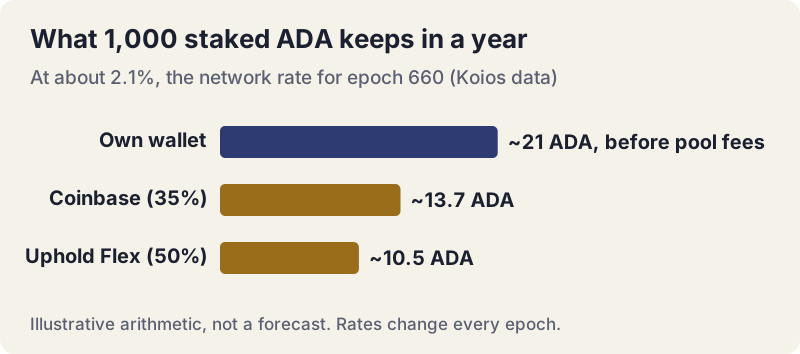
On those numbers, the cost of convenience is visible. An exchange that keeps 35% of rewards turns about 21 ADA into about 13.7 ADA on 1,000 ADA a year, and it holds your coins while it does so. Kraken also stakes ADA for US clients in eligible states, but not for residents of New York or Maine, and publishes its commission schedule; Kraken's staking and Coinbase's staking links here are affiliate links. Delegating from a wallet you control pays us nothing and is the route Cardano was built around.
How to stake ADA from your own wallet
- Choose a wallet that supports delegation, such as Daedalus, Eternl or Yoroi, from its official site, and back up the recovery phrase offline.
- Move your ADA from the exchange to a receiving address in that wallet, starting with a small test amount.
- Pick a pool by its fixed cost, margin, pledge and whether it is close to saturation; avoid pools that promise rewards above the network rate.
- Delegate, paying the 2 ADA refundable deposit and the network fee, and keep the pool ID somewhere safe.
- Set a DRep choice, a named DRep or abstain, so you can withdraw rewards when you want them.
For the other networks we cover, compare this with Ethereum staking and Solana staking, where unbonding and penalties work differently, or start from our how to stake crypto guide for the methods across all chains.
Edge cases
- Your pool retires or stops making blocks. Your ADA is safe in your wallet; you simply stop earning until you delegate elsewhere.
- You want the 2 ADA back. Deregister the stake key; the deposit is returned, but you stop earning.
- A site offers a much higher ADA yield. Ordinary delegation pays roughly the network rate. A figure far above it means lending, a token incentive or a scam, not staking.
- Taxes. Staking rewards are generally taxable when you receive them in the US; our staking taxes note covers the detail.
Cardano staking: common questions
Is staking Cardano safe?
How long does Cardano staking take to pay?
What is the Cardano staking APY in 2026?
Why can't I withdraw my Cardano staking rewards?
Do I need a minimum amount to stake ADA?
Keep reading: how to stake crypto safely, method by method, or the risk-first take on whether crypto staking is safe. None of this is financial advice.