Solana Staking Explained: Native, Liquid and Exchange Routes
Staking Solana means delegating your SOL to a validator so it counts towards securing the network, and in return you receive a share of newly issued SOL each epoch, roughly every two days. On 10 October 2026, Solana's network data implied a gross reward of about 5.2% a year before the validator's commission, against supply inflation of about 3.6%, so a staker's real gain relative to the growing supply was nearer 1.3% than 5%. Staking mostly protects you from being diluted; it is not a high-yield product, and the SOL price will move your result far more than the rate does.
There are three ways in: delegate natively from your own wallet, use a liquid-staking protocol, or let an exchange do it. Each keeps a different share of the reward and adds a different risk. This field note works through the mechanics, the arithmetic and the trade-offs, using figures read from the network and from providers' own pages. For how Solana sits among the other staking methods, start with the how-to-stake guide.
How Solana staking works: validators, delegation, epochs
Solana is a proof-of-stake network: validators vote on blocks, and the weight of each vote depends on the SOL delegated to it. You do not need to run anything yourself. You create a stake account from your wallet, move SOL into it, and delegate that stake to a validator of your choice. The SOL never leaves your control; the validator receives voting weight, not your coins, and you can redelegate or withdraw later.
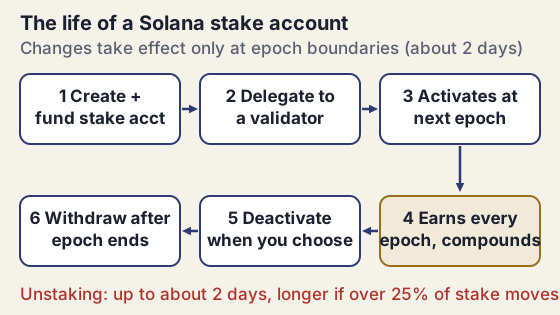
Timing is set by epochs. Per Solana's own staking page, an epoch lasts about two days, stake only activates or deactivates at an epoch boundary, and no more than 25% of the network's active stake can activate or deactivate in a single epoch. Rewards are paid in the first block of the following epoch into the stake account itself, so they compound automatically. You can check where the current epoch stands in most wallets; on 10 October 2026 the network was in epoch 1053.
One detail matters for risk. Solana's documentation states that slashing is not automatic: there is no built-in penalty that burns delegated stake when a validator misbehaves, in contrast with Ethereum. That does not make validator choice irrelevant. A validator that goes offline earns nothing for you while it is down, and one that raises its commission takes more of your reward from the next epoch. Our note on what slashing is explains how the penalty works on networks that do enforce it.
Three ways to stake SOL, compared
The three routes differ in who holds your SOL, what they keep, and how fast you can get out. Native delegation is the purest: you keep custody and pay only the validator's commission. Liquid staking hands your SOL to a smart contract that delegates across many validators and gives you a token such as mSOL or JitoSOL that you can sell at any time. Exchange staking is the simplest and the most custodial: the platform holds your SOL, stakes it, and passes on rewards after its own cut.
| Route | Who holds the SOL | What you pay | Getting out | Main added risk |
|---|---|---|---|---|
| Native delegation (wallet such as Phantom or Solflare) | You | Validator commission only (median 5%) | End of current epoch, about 2 days | Choosing a poor validator |
| Liquid staking (Marinade mSOL, JitoSOL) | A smart contract | Marinade: no reward fee; delayed unstake 0.2% for mSOL | Sell the token any time, or redeem via the protocol | Contract exploit; token trading below SOL |
| Exchange (Coinbase, Kraken) | The exchange | Kraken: 25% of rewards bonded (under $1M), 30% flexible; Coinbase: 35% standard | Kraken: 3-day unbonding (bonded) or instant (flexible) | Custodial: freeze or failure |
Marinade's figures come from its fees page: no deposit fee and no performance fee on staking rewards, a 0.2% fee for a delayed mSOL unstake, and 0.03% to 1.5% for an instant unstake through its liquidity pool, with validator commissions still applying underneath. Jito charges a protocol fee on JitoSOL rewards; its current figure was not readable at the time of writing, so check its fee page before you deposit. Coinbase's fee disclosures, read on 10 October 2026, list a standard 35% commission on SOL rewards (lower for paid Coinbase One members), and the rate it displays is already net of that cut. Kraken publishes more detail: its Solana staking page, read on 10 October 2026, displayed 5.36% for bonded SOL, with a 3-day unbonding period, and 2.65% for flexible SOL, both before the commission set out in its on-chain staking overview (last updated 19 August 2026): 25% on bonded balances under $1M and 30% on flexible staking. After that cut, bonded SOL works out to about 4.0% and flexible to about 1.9%; the flexible figure is lower partly because Kraken stakes only up to half of flexible deposits to keep them liquid.
If you want the least moving parts and do not plan to touch a wallet, an exchange is the honest convenience pick, at the price of custody. Kraken and Coinbase both offer SOL staking in the app; compare the reward rate each displays after its own cut, and remember that the 2022 platform failures are why custody is the first question, not the last. If you already use a self-custody wallet, native delegation keeps your keys and costs the least, and it pays us nothing.
What you earn: APY vs inflation, the real yield
Solana's rewards are new issuance. The protocol's inflation schedule started at 8% a year, falls by 15% of its value each year, and stops at a long-term floor of 1.5%, per Solana's staking page and the network's inflation governor (initial 0.08, taper 0.15, terminal 0.015). On 10 October 2026 the network reported a current inflation rate of 3.61%. Two proposals to change the schedule, SIMD-0228 and SIMD-0411, were both closed on GitHub without being merged, so the fixed taper still applies.
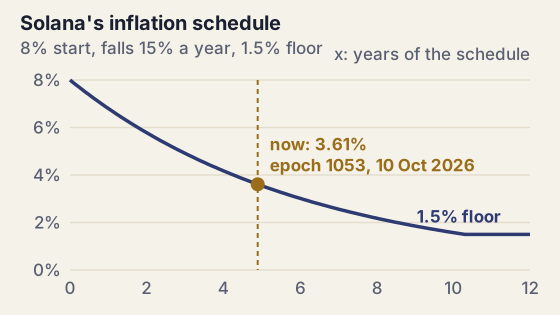
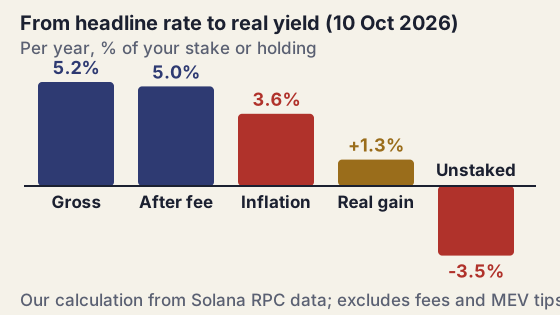
That issuance is shared only among staked SOL. On 10 October 2026 about 437.9 million of 635.5 million SOL was actively staked, roughly 69%. Spreading 3.61% of total supply across 69% of it gives a gross base reward of about 5.2% a year, before the validator's commission and excluding any priority fees or MEV tips a validator passes on. That is our calculation from the network's numbers, not a rate any provider quotes, and it moves every epoch.
Now subtract what you are being diluted by. Every holder's share of supply shrinks by the inflation rate whether they stake or not. A staker who earns about 5.0% after a 5% commission while supply grows 3.6% ends the year with roughly 1.3% more of the network than they started with. A holder who does not stake ends with about 3.5% less. Seen that way, staking SOL is mostly a defence against dilution, which is exactly the point our note on why a high APY is a red flag makes about every inflationary network.
A worked example (the staking calculator answer)
Delegate 100 SOL natively to a validator charging 5% commission. At the 10 October 2026 network figures, gross issuance on that stake is about 5.24 SOL a year; the validator keeps about 0.26 SOL; you receive about 4.98 SOL, compounded each epoch, so slightly more by year-end. Because inflation tapers, next year's base rate will be lower unless the staked share falls. And all of it is denominated in SOL: if SOL halves, your 104.98 SOL is still worth about half what you started with. Treat any calculator, ours included, as arithmetic about SOL, never as a dollar projection.
Choosing a validator: commission, uptime and the 100% trap
Commission is the share of rewards a validator keeps, and it varies more than most guides admit. Reading the network's vote accounts on 10 October 2026: about 675 validators were active, the median commission was 5%, and roughly a third of validators charged nothing. At the other extreme, more than 60 validators charged 100% commission, together holding about 24% of all active stake. Delegate to one of those and you receive no inflation rewards at all. Wallets usually show commission next to each validator; read it before you click, and check again occasionally, since a validator can change it.
Beyond commission, look for a validator that has been reliably online, since one that misses votes earns less for its delegators, and consider whether it already holds a very large share of stake. Concentration is a network risk: the more stake a handful of operators control, the easier coordinated failure or censorship becomes. Delegating to a well-run smaller validator is a small, practical way to support the decentralisation that gives the network its value. Splitting stake across two or three validators also limits the damage if one of them goes offline.
Liquid staking tokens and their risks
Liquid staking solves the unstaking wait by giving you a token you can sell instead. Deposit SOL with a protocol such as Marinade or Jito and you receive mSOL or JitoSOL, which rises in value against SOL as rewards accrue. The protocol spreads deposits across many validators, which removes the validator-picking job from you. Our general note on liquid staking covers the mechanism across networks.
What you take on in exchange is specific. Your SOL now sits in a smart contract, so a bug or exploit in that code can drain it, however many audits it has had. The token can trade below the SOL it represents when many holders rush to sell at once, which is exactly when you are most likely to want out; Marinade's own instant-unstake fee runs up to 1.5%, a sign that immediate liquidity has a price. And the US SEC staff statement of 29 May 2025, which set out the agency staff's view that certain protocol staking does not involve securities offerings, expressly does not address liquid staking or restaking, so the regulatory position of these tokens is less settled than plain delegation.
How long does it take to unstake SOL?
Natively, you deactivate the stake account and it becomes withdrawable at the end of the current epoch, so anywhere from moments to about two days depending on where in the epoch you start. If a large share of the network is unstaking at once, the 25%-per-epoch limit can stretch that over several epochs. Once deactivated, you withdraw the SOL back to your wallet in an ordinary transaction. Liquid stakers can sell the token immediately at the market price or wait for a delayed redemption at full value. On an exchange, the platform sets the timing and may process it differently from the network's own schedule; our note on lock-up and unbonding periods compares networks.
Edge cases worth knowing before you stake
- Your validator shuts down. Your stake stays in your stake account; it just stops earning. Deactivate and redelegate to another validator.
- Your validator raises its commission. The new rate applies to future rewards. Watch for it in your wallet and move if it no longer suits you.
- You stake through a hardware wallet. Supported wallets can create and delegate stake accounts while the signing key stays on the device, which keeps custody cold while earning.
- You need the SOL quickly. Native stake cannot be hurried past the epoch boundary. If speed matters, liquid staking or an unstaked reserve is the answer, not a bigger stake.
- Tax. In the US, the IRS position (Rev. Rul. 2023-14) is that staking rewards are income when you gain control of them, valued at that time. Our staking taxes note explains what that means in practice.
The common thread is that Solana staking is flexible where Ethereum's is rigid, and rigid where it matters least. You can move between validators every couple of days, but you cannot make the rewards outrun inflation by much, and you cannot make SOL less volatile. Stake for the dilution protection and the modest real gain, choose the route whose custody model you are comfortable with, and size it as SOL you could hold through a steep drawdown. This is education, not financial advice.
Common questions about staking
What is the current Solana staking APY?
Is staking Solana worth it?
How long does it take to unstake SOL?
Can you lose SOL by staking?
What is the best way to stake Solana?
Keep reading: how to stake crypto safely, method by method, or the risk-first take on whether crypto staking is safe. None of this is financial advice.