Can You Stake XRP or Bitcoin? What "Staking" Offers Really Are
No, not in the sense that ETH or SOL can be staked. The XRP Ledger runs without proof-of-stake and pays its validators nothing, and Bitcoin is secured by proof-of-work mining. So every product advertising "XRP staking" or "BTC staking" is paying you from somewhere else: lending your coins to borrowers, wrapping them into a token on another chain, or, in Bitcoin's case, locking them to secure a different network through a protocol called Babylon. Some of those are legitimate, but each carries a risk that real staking does not, and the yields are often far smaller or far less safe than the marketing suggests.
If you hold XRP or BTC for their own sake, the safest yield on them is usually none at all. If you want staking rewards, the honest route is to stake a proof-of-stake asset directly, which our how-to-stake guide covers. This field note explains each mechanism so you can tell what you are actually being offered.
Why XRP and Bitcoin can't be staked natively
Staking exists on proof-of-stake networks, where validators lock up the network's own coin as collateral and are paid newly issued coins and fees for honest work. Neither ingredient exists on the two networks people most often ask about. On the XRP Ledger, each participant chooses a list of validators it trusts, called a Unique Node List, and consensus emerges from those lists. Validators put up no collateral, and the XRPL FAQ says running one is not rewarded with XRP. With no stake to lock and no reward to share, there is nothing to stake.
Bitcoin is secured by miners spending electricity, and new bitcoin goes to them. Holding BTC does nothing for the network's security, so the protocol has no reason to pay holders. Ripple has publicly discussed whether the XRP Ledger could one day support some form of native staking, as Decrypt reported in November 2025, but nothing of the sort had launched as of 9 October 2026, and Ripple's own news page announced no such feature. Our explainer on what crypto staking is covers the proof-of-stake model in general.
Where the yield actually comes from
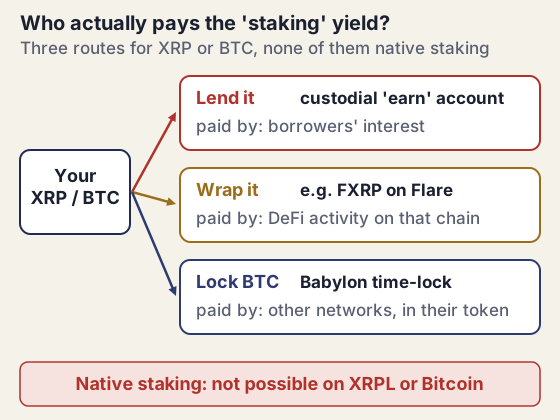
Strip away the branding and every XRP or BTC yield traces back to one of three sources. Each moves your coins, or the right to use them, to someone else, and that transfer is where the risk sits.
Mechanism 1: lending dressed up as staking
The most common "XRP staking" offer is a custodial earn or savings account. You deposit coins with a platform, it lends them to borrowers or deploys them in trading strategies, and it pays you part of the interest. Nothing is being staked; the yield is a lender's margin, and you are an unsecured creditor of the platform. That distinction is the subject of our note on staking vs lending, and it is the key point to grasp before accepting any of these offers.
The 2022 collapses show what that means in practice. Celsius, which marketed high yields on deposits, went bankrupt. By the end of 2024, after two plan distributions, its eligible creditors had got back roughly 60% of what their claims were worth in dollars on the bankruptcy date, per the claims agent's court filings, paid in cash or liquid crypto rather than as their own coins returned one for one. BlockFi did better: in July 2024 its estate told clients to expect full repayment, in dollars, of their allowed claims, roughly a year and a half after it filed for bankruptcy. In January 2023 Nexo agreed to pay $45 million in combined SEC and state penalties over its unregistered earn product; it returned to US customers on 16 February 2026, now offering products it calls Yield.
That does not make every lending product a fraud. It means the right comparison is with a loan to a company, not with staking. Read whether the platform lends out client assets, what happens in insolvency, and where you would rank as a creditor before you deposit. A rate quoted on BTC or XRP by a custodial platform is compensation for that credit risk, so a higher rate means more of it.
Mechanism 2: wrapped tokens on proof-of-stake chains
The second route moves your coins onto a chain that does support DeFi. You give up the original XRP or BTC to a bridge or custodian and receive a wrapped token on the other chain, which you can then lend, provide as liquidity or deposit into vaults. Custodian-issued wrapped bitcoin tokens work this way on Ethereum and other networks. For XRP, the main example is FXRP on Flare: Flare's FAssets system went live with FXRP on 24 September 2025, and Flare reported about 145.2 million FXRP minted by its first anniversary. Flare describes FAssets as an over-collateralised bridge, with agents posting collateral in stablecoins or ETH plus Flare's own tokens.
The yield here comes from the activity on the other chain, and Flare itself describes its vaults as actively managed strategies, not fixed-rate savings products, with returns that move week to week. The risks stack: the bridge or its agents could fail, the smart contracts could be exploited, and the wrapped token could trade below the coin it represents. Note too that Kraken's eligibility page says Flare staking is not available to US clients. Wrapping is a real technology, but the word "staking" in front of it describes the other chain, not your XRP.
Mechanism 3: Bitcoin staking through Babylon
Babylon is the best-known design that lets bitcoin earn rewards without leaving the Bitcoin blockchain. According to Babylon's documentation, you lock BTC in a Bitcoin script that you control, with a time-lock, and that locked BTC acts as security collateral for other proof-of-stake networks. Those networks pay rewards in their own tokens. In return, the protocol can slash part of the locked bitcoin if the security rules are broken. So the BTC is still self-custodial, but it is now at risk for someone else's network.
Kraken is the most prominent mainstream venue offering it. Its support page, last updated 23 September 2026 and read on 10 October 2026, showed an estimated reward of 0.02% a year on staked bitcoin, paid in Babylon's BABY token, before a Kraken commission of 10% to 26%. Bonded stakes take about 7 days to unbond, and the service is offered only in the US (excluding Maine and New York), the UK, Australia and the UAE. Kraken says it will compensate slashing losses except in listed circumstances. In other words, the most mainstream Bitcoin staking product paid almost nothing on the day we checked, in a token other than bitcoin.
XRP specifically: Flare, AMMs and what Ripple has said
XRP holders have one native way to earn on the XRP Ledger itself: providing liquidity to its built-in automated market makers. Per the XRPL documentation, you deposit a pair of assets into a pool, receive LP tokens representing your share, and earn a portion of the trading fees, which liquidity providers vote to set between 0% and 1%. That is not staking either. It is market-making, and it carries the usual liquidity-provider risk that if one asset in the pair falls sharply, you end up holding more of it.
Mainstream US exchanges mostly do not offer XRP staking at all, which is itself a clue. Coinbase's US Earn page listed seven stakeable assets when we read it on 10 October 2026 (ETH, SOL, ADA, AVAX, DOT, ATOM and XTZ), with neither XRP nor BTC among them, and Uphold's US staking page did not list XRP either. The XRP yields you do see are lending products: Nexo's global earn page displayed "up to 6.25%" a year on XRP on 10 October 2026, a top-loyalty-tier rate that Nexo says may vary by region and tier and is not guaranteed.
Beyond that, the options are the ones above: lend it to a custodial platform, or wrap it into FXRP and use it on Flare. If you see a product promising a fixed or "guaranteed" XRP staking rate, it is one of these mechanisms with the risk hidden, or a scam. The search results for these terms are full of pages pushing exactly that, which is why it pays to ask, every time, who is paying the yield and why.
XRP and BTC yield routes side by side
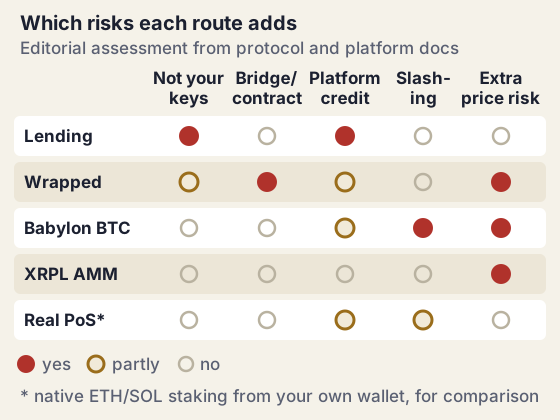
Put the routes next to each other and the pattern is plain: the higher the displayed rate, the more of your coins' safety you hand to someone else. Every figure below is as displayed on the date shown, is variable and is not a promise. Rates also mean different things: a lending rate is paid by a borrower, while a staking rate is paid by a network.
| Route | Example we checked | Who pays the yield | Who holds your coins | Main added risk |
|---|---|---|---|---|
| Custodial lending ('earn') | Nexo: up to 6.25% on XRP and 4.7% on BTC, top loyalty tier | Borrowers and the platform's own strategies | The platform | Platform failure; you are an unsecured creditor |
| Wrapped XRP (FXRP on Flare) | About 145.2 million FXRP minted by 24 Sep 2026; vault returns move week to week | DeFi activity on Flare | Bridge agents and smart contracts | Bridge failure, exploit or depeg |
| Babylon BTC staking | Kraken: estimated 0.02% a year, paid in BABY, before a 10-26% commission | Other proof-of-stake networks, in their own token | A time-locked Bitcoin script | Slashing; the reward token's price |
| XRPL AMM liquidity | Pool trading fee set by LP vote between 0% and 1% | Traders swapping in that pool | The ledger's AMM pool, via your LP tokens | Losing value as the pair's prices diverge |
| Real PoS staking (for comparison) | Coinbase showed 1.70% on ETH and 3.27% on SOL on 10 Oct 2026 | The network: new coins plus fees | You, or your exchange | Coin price, unbonding waits, slashing |
Red flags in 'stake XRP' and 'BTC staking' offers
- A fixed or guaranteed rate. Real network rewards vary. A promised number is a lender's promise or a marketing claim.
- No explanation of the mechanism. If the page will not say whether it lends, wraps or uses Babylon, assume the riskiest option.
- Rewards far above the norm. A high rate on a coin that cannot be staked means someone is taking a big risk with your coins.
- A lock-up with no clear exit terms. You should know exactly how and when you can withdraw before you deposit.
- Pressure, referral bonuses or 'limited' pools. The playbook of every failed yield scheme.
- Unsolicited messages offering to stake for you. Legitimate platforms do not DM you; see our note on crypto staking risks.
If you want real staking rewards instead
If the goal is a staking yield rather than a yield on XRP or BTC specifically, the cleaner path is to stake a proof-of-stake asset on its own network. On Ethereum or Solana you can delegate from your own wallet and keep custody, or use a mainstream exchange if you accept the custodial trade-off: Kraken publishes its staking commissions openly, and Coinbase lists a standard 35% commission on ETH and SOL rewards in its fee disclosures. Our ETH staking guide and is crypto staking safe cover the details.
Swapping XRP or BTC into another coin to stake it is a different investment decision, not a yield upgrade, and in the US it is a taxable sale. Do not let a staking rate talk you into an asset you would not otherwise hold. In the US, staking rewards are income when you receive them under the IRS's Revenue Ruling 2023-14, and interest-style rewards are generally taxable too; our staking taxes note explains more. This is education, not financial advice.
Common questions about staking
Can you stake XRP?
Can you stake Bitcoin?
Is XRP staking safe?
What is Babylon Bitcoin staking?
Where can I earn rewards on XRP?
Keep reading: how to stake crypto safely, method by method, or the risk-first take on whether crypto staking is safe. None of this is financial advice.